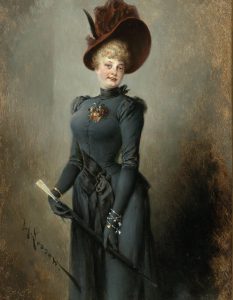
Introduction Before department stores, before boutiques, before you could browse online—fashion came to you. The milliner visiting homes with hatboxes and samples was standard practice for upper and middle-class women who couldn’t or wouldn’t shop in public commercial spaces. This domestic commerce created interesting social dynamics, blurring lines between service provider and social caller, between …
Introduction The profile portrait offers something the frontal portrait doesn’t—the subject doesn’t meet our gaze. They look away, absorbed in their own thoughts or focused on something beyond the frame. We see them, but they don’t see us. This creates different intimacy than direct eye contact—we observe rather than engage, study rather than connect. Heinrich …
Introduction Heinrich Lossow painted people—their flirtations, vanities, domestic moments, historical costumes. So when he painted “A Waterfall In The Forest,” he stepped outside his usual subject matter into landscape territory, which raises the question: why? Waterfalls were enormously popular subjects in 19th-century art. They represented nature’s power and beauty, offered visual drama with cascading water …
Introduction Heat matters. Before central heating, before radiators humming invisibly in walls, staying warm required intention and proximity. Heinrich Lossow’s “Couple By Stove” captures this physical reality that shaped social life—the stove as gathering point, as reason to draw close, as excuse for intimacy that might otherwise seem too forward. The painting shows what seems …
Introduction Before recorded music, before radio, before you could summon any song instantly from your pocket—music was something you made, not just consumed. Heinrich Lossow’s “Musical hobbies” (German: “Musikalische Unterhaltung”) captures era when playing instruments and singing together was normal social activity, when entertainment meant performing rather than passively listening, when making music was essential …
Introduction Most people stayed put. In 1867, when Heinrich Lossow painted “Travelling People,” the majority of Europeans lived and died within miles of where they were born. Movement was expensive, difficult, often dangerous. So people who traveled—by choice or necessity—were notable, sometimes suspicious, occasionally romantic figures who defied the settled order most people inhabited. The …
Introduction Dogs don’t judge. They don’t care about social position, appropriate behavior, or whether you’re performing femininity correctly. Heinrich Lossow’s “Girl and Her Dog On Garden Bench” captures something essential about why children and animals connect so deeply—both exist partly outside adult human social systems that demand constant performance and conformity. The painting shows simple …
Quick Facts: The Little Darling Artist: Heinrich Lossow Subject: Child depicted with Victorian sentimentality Theme: Childhood innocence, Victorian idealization, parental love Cultural Context: 19th-century cult of childhood Style: Academic child portraiture Term “Darling”: Both affection and possession Class Dimension: Childhood as privilege Introduction Children weren’t always precious. The Victorian obsession with childhood innocence, with children …
Quick Facts: Love Whispers 1897 Created: 1897 Artist: Heinrich Lossow (age 57) Subject: Lovers sharing intimate whispered conversation Theme: Intimacy, privacy, romance, shared secrets Style: Academic painting from Lossow’s mature period Mood: Tender, intimate, private Symbolism: Whisper as boundary-making, creating two-person world Introduction Some things can only be said quietly. Heinrich Lossow’s 1897 painting “Love …
Introduction Some rooms are for public display. Others are sanctuaries, hidden from the world. Heinrich Lossow’s “The Boudoir” (German: “Die Putzmacherin”) takes us into one of the most private feminine spaces of 19th-century life—the boudoir, where women prepared themselves for public appearance while remaining in intimate privacy. This wasn’t just a room. It was a …
Paintings
Find more articles and illustrations in the collection.