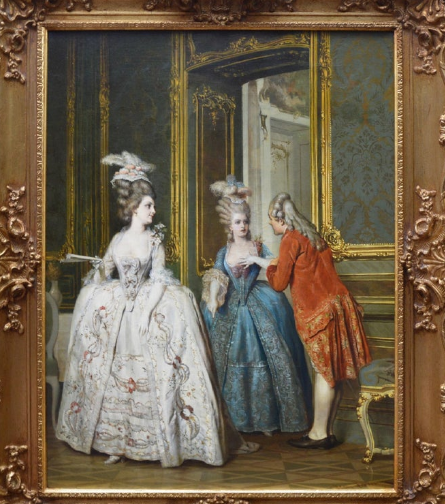
Marie Antoinette and Marie Thérèse at Versailles by Heinrich Lossow

Introduction

There’s unbearable poignancy in Heinrich Lossow’s “Marie Antoinette and Marie Thérèse at Versailles”—not because of what it shows, but because of what we know comes next. The painting depicts a peaceful domestic moment between France’s queen and her daughter in the gilded magnificence of Versailles. It’s tender, intimate, beautiful. And it’s doomed.

Quick Facts: Marie Antoinette at Versailles

Subject: Marie Antoinette with daughter Marie Thérèse
Setting: Palace of Versailles
Period Depicted: Late 18th century, pre-Revolution
Marie Antoinette: 1755-1793 (executed)
Marie Thérèse: 1778-1851 (sole survivor of family)
Style: Historical genre painting
Emotional Tone: Tender mother-daughter moment

Quick Facts: Marie Antoinette at Versailles

Subject: Marie Antoinette with daughter Marie Thérèse
Setting: Palace of Versailles
Period Depicted: Late 18th century, pre-Revolution
Marie Antoinette: 1755-1793 (executed)
Marie Thérèse: 1778-1851 (sole survivor of family)
Style: Historical genre painting
Emotional Tone: Tender mother-daughter moment

Marie Antoinette will die on the guillotine. Her daughter will watch her entire family destroyed. This gentle scene at Versailles will become impossible, literally—the palace stormed, the monarchy overthrown, the world they knew annihilated. But Lossow painted them before all that, in a moment of ordinary maternal affection that makes what follows so much more tragic.

The painting isn’t historical documentation—Lossow invented this specific scene decades after both women were dead. But it’s emotionally true in ways that matter more than factual accuracy. It shows us what was lost when the Revolution came: not just a political system or social order, but private moments of human connection between a mother who loved her daughter and a daughter who loved her mother back.

Who They Really Were

Marie Antoinette arrived in France at fourteen, married to the future Louis XVI in a political arrangement between Austria and France. She was pretty, spoiled, frivolous—and terrifyingly young for the role thrust upon her. History has alternately demonized her as a callous aristocrat indifferent to suffering (“let them eat cake”—which she never actually said) and romanticized her as a tragic victim of revolutionary excess.

The truth is more complicated and more human. She was a woman trapped in an impossible situation, playing a role she never quite understood, blamed for things beyond her control while genuinely failing at things within it. She loved luxury, fashion, and pleasure—hardly surprising for someone raised in imperial splendor and married into French royalty. She also loved her children with what appears to have been genuine maternal devotion.

Marie Thérèse Charlotte, born December 19, 1778, was her first daughter. Called “Madame Royale” as the king’s eldest daughter, she grew up in privilege so extreme it’s nearly unimaginable—literally raised at Versailles, surrounded by servants, educated by the finest tutors, destined for a royal marriage that would cement political alliances.

What makes their story heartbreaking is that Marie Thérèse was the only one who survived. When the Revolution came, they imprisoned the entire family. Marie Antoinette died first, guillotined in October 1793. Her husband followed. Her son died in prison, probably from neglect and abuse. Marie Thérèse alone survived—released in 1795, traumatized, having watched her family destroyed, carrying those memories for the rest of her long life.

The Scene Lossow Imagined

Lossow’s painting shows mother and daughter together at Versailles in a private moment—no ceremony, no courtiers, just the two of them in that opulent setting. This is invention, not historical documentation. Lossow painted it in the 19th century, decades after both women were dead, imagining what such moments might have looked like.

But the invention serves truth. These moments happened, even if this specific one didn’t. Marie Antoinette did spend time with her daughter. They did have private exchanges in Versailles’s gilded rooms. The painting captures the spirit of what must have occurred countless times, even if the details are fabricated.

Lossow dressed them in elegant 18th-century court fashion—the kind of elaborate, beautiful clothing that would later be cited as evidence of Marie Antoinette’s extravagance. The setting is Versailles at its most luxurious: fine furniture, ornate decoration, all the visual markers of a world of privilege and power. Yet somehow the intimacy between mother and daughter makes all that luxury feel secondary—human connection mattering more than gold and silk.

The Tenderness That Makes It Hurt

What gives the painting emotional power isn’t grandeur—it’s gentleness. This could be any mother with any daughter, except it’s not. It’s a queen who will die violently and a daughter who will survive traumatically, captured in a moment before history’s cruelty intrudes.

Lossow understood what makes historical tragedy work: you need to care about the people involved as people, not just as historical figures or symbols. Marie Antoinette the Abstract Symbol of Aristocratic Excess is easy to condemn or dismiss. Marie Antoinette the actual mother holding her actual daughter becomes harder to reduce to historical abstraction.

The painting humanizes them deliberately. It strips away the political and symbolic to show what the Revolution would destroy: not just a monarchy or system, but real people who loved each other, who had private moments of connection, whose lives had value beyond their historical roles.

This might be sentimental, but sentimentality can be a form of truth. Yes, Marie Antoinette lived in outrageous luxury while others starved. Yes, the monarchy she represented deserved to fall. But she was also a real person capable of loving her child, and her daughter was an innocent child who would suffer for things she didn’t do. Both things can be true.

Why Versailles Matters

Lossow painted Versailles not just as setting but as character. All that gilded excess, those elaborate decorative details, the expensive furniture and ornate architecture—they’re not just beautiful. They’re evidence. Evidence of resources poured into luxury while people starved. Evidence of a world where some lived like gods while others barely survived.

Yet Lossow doesn’t make Versailles ugly or grotesque. He paints it beautifully because it was beautiful. The French monarchy’s crime wasn’t creating ugliness—it was creating beauty for themselves while others suffered. Making Versailles look beautiful in the painting makes the historical point more effectively than making it look decadent would. Beauty this extreme, this exclusive, this expensive—that’s the problem.

The intimate mother-daughter scene set against such opulent background creates productive tension. Their private affection is real and touching. The setting that frames it represents everything historically unjust about their position. Viewers can feel both things simultaneously: sympathy for these specific people and awareness of the system that enabled their privilege.

The Painting’s Lies and Truths

Let’s be clear: this painting lies. It’s not documentary. Lossow invented this scene. We don’t know if Marie Antoinette ever sat exactly like this with Marie Thérèse, in this room, wearing these clothes. We don’t know what their actual private moments looked like.

But the painting tells a different kind of truth. Marie Antoinette did love her daughter—that’s well-documented. They did spend time together. They did have maternal affection. Those things really happened, even if this specific moment didn’t. The painting is emotionally true even while being factually invented.

This is what historical genre painting could do at its best: capture the spirit of an era, the feeling of historical moments, the human reality behind historical facts. Lossow researched period details carefully—the clothing, furniture, decorative elements all reflect genuine 18th-century styles. Then he used that period accuracy to frame an emotional scene that conveys historical feeling even more than historical fact.

The painting also lies through omission. It doesn’t show the poverty existing outside Versailles. It doesn’t depict the political circumstances leading to revolution. It doesn’t suggest that this world is unsustainable. It’s deliberately partial—showing only one aspect of a complex historical reality.

But art doesn’t have to show everything. Sometimes focusing on one truth—that human love existed even in unjust systems, that powerful people still felt real emotions, that victims of historical forces were actual people—serves its own important purpose.

The Daughter Who Survived

Marie Thérèse’s survival makes the painting more poignant. She lived until 1851—long enough to write memoirs, to remember her mother, to testify to what the Revolution destroyed and what it cost her personally. Reading her later writings makes Lossow’s painting almost unbearable—she remembered her mother, missed her, carried that loss for decades.

The painting shows what Marie Thérèse would remember: not political abstractions or historical forces, but her mother. The person who raised her, who loved her, who existed beyond her role as queen. When Marie Thérèse thought about her mother in later years, she probably remembered moments like the one Lossow painted—ordinary instances of maternal affection in extraordinary surroundings.

That Marie Thérèse was the sole survivor of her immediate family adds another layer. She alone carried these memories. She alone lived to testify to what was lost. Everyone else who shared these moments—parents, siblings, the world of Versailles itself—gone. Only her memory preserved what those private times had been like.

Lossow painted his scene decades after Marie Thérèse had already endured all this loss and memory. The painting looks backward at a past that by the time of its creation had been doubly lost—first to revolution, then to time as even the survivors died. There’s a memorial quality to it, a preserving of something already vanished.

The Frame’s Golden Irony

The painting’s original Louis XVI style frame—if accounts are accurate—adds fascinating meta-commentary. The frame style mimics the very era the painting depicts, creating continuity between content and presentation. But it also highlights the distance. That frame in the 19th century was historical revival, nostalgic recreation of a lost aesthetic. Like the painting itself, the frame looks backward at a vanished world with something like longing.

There’s irony in this. A style named after the king who died on the guillotine, framing a painting of his wife and daughter in happier times. The frame itself becomes a kind of memorial to that lost world—preservation through recreation, keeping alive an aesthetic even as the political reality it represented was rightfully destroyed.

The frame also signals something about the painting’s intended audience. Collectors wealthy enough to commission or purchase such elaborate framing were often sympathetic to aristocratic values, nostalgic for pre-revolutionary order. The painting and its frame together created a complete package for people who mourned what the Revolution destroyed, even if they couldn’t or wouldn’t defend the injustices it ended.

Why 19th-Century Audiences Wanted This

Lossow painted “Marie Antoinette and Marie Thérèse at Versailles” during a period of intense nostalgia for pre-Revolutionary France among certain European audiences. The violence of 1789-1799 was far enough past to seem romantic, close enough to remember as cautionary tale.

For aristocratic collectors, paintings like this validated their class position. See, it said, aristocrats are human too. They love their children. They have tender moments. The system that gave them such luxury also enabled this domestic happiness. Maybe overthrowing it wasn’t unambiguously good.

For bourgeois collectors, the painting offered vicarious aristocratic elegance. They could own a piece of that refined world, hang it in their homes, participate in the aesthetic even while knowing the political system was indefensible. It was safe historical romance—you could enjoy the beauty without supporting contemporary monarchy.

Both groups could appreciate the painting as technical achievement—Lossow’s skill in rendering fabrics, interiors, period detail. And both could respond to the universal content: parent and child, love within family, private affection that transcends historical circumstances.

The painting let viewers have it both ways: acknowledge that the Revolution might have been historically necessary while still feeling genuine sympathy for its aristocratic victims. It’s liberal enough to attract those who support political reform, conservative enough to appeal to those nostalgic for lost certainties.

What We See Now

Contemporary viewers bring different perspectives. We’re less likely to romanticize aristocracy, more aware of systemic injustice, more critical of wealth inequality. The painting’s luxury makes us uncomfortable in ways it might not have bothered 19th-century audiences.

Yet the mother-daughter relationship still resonates. Whatever we think about monarchy or revolution, the painting shows two people who loved each other and would be separated by historical forces beyond their control. That’s tragedy in the classical sense—suffering that seems both inevitable and undeserved.

We can hold multiple truths simultaneously: Marie Antoinette’s privilege was obscene. The system she represented deserved destruction. Yet she loved her daughter genuinely, and her daughter loved her, and their separation and her death were traumatic regardless of political justification. Personal tragedy and historical necessity can coexist.

The painting works for modern viewers precisely because it doesn’t try to adjudicate these competing claims. It doesn’t argue that the Revolution was wrong or that monarchy was justified. It simply shows two people in a moment of connection before history destroyed them. What we make of that—how we balance sympathy for individuals against judgment of systems—remains our choice.

The Painting’s Quiet Power

“Marie Antoinette and Marie Thérèse at Versailles” doesn’t scream or shock. It doesn’t provoke like “The Sin” or symbolize dramatically like “The Enchantress.” It simply shows a mother and daughter together in a beautiful room, and lets history provide the context that makes it heartbreaking.

This quiet approach has its own power. Lossow trusted the subject to carry emotional weight without melodrama. He trusted viewers to know the history, to understand what comes next, to feel the poignancy without him having to spell it out. The painting’s restraint makes it more affecting than histrionics would be.

The technical mastery serves this emotional core without overwhelming it. Yes, Lossow painted those fabrics beautifully, rendered the room convincingly, captured light and color skillfully. But all that technique creates believability that makes the emotion work. We believe in these people because Lossow painted them well enough that they seem real.

Conclusion: Before the Fall

Heinrich Lossow’s “Marie Antoinette and Marie Thérèse at Versailles” captures a moment that might never have existed exactly as painted but represents something absolutely real: a mother’s love for her daughter, tested and ultimately destroyed by historical forces neither could control.

The painting works as memorial, preserving in pigment what revolution and time erased. It works as tragedy, showing us happiness we know is doomed. It works as human document, reminding us that historical figures were actual people with real emotions and relationships beyond their political roles.

Most powerfully, it works as a meditation on what violence destroys. The Revolution overthrew a corrupt system—necessary, arguably inevitable. But in doing so, it also tore apart families, killed people who loved each other, destroyed private happiness along with public injustice. Both can be true. Both matter.

Lossow painted them in that suspended moment before history’s cruelty—before the mob, before the prison, before the guillotine. He gave us Marie Antoinette as mother rather than symbol, Marie Thérèse as daughter rather than historical survivor. In doing so, he created something that history’s sweep usually erases: recognition of the human cost of even justified political violence.

The painting asks us to hold complexity, to feel sympathy without abandoning judgment, to acknowledge that people we might condemn politically can still love genuinely, and that love’s destruction is tragic even when historically necessary. That’s harder than simple moral clarity, but it’s more truthful. And sometimes art’s job is exactly that: making us feel the complicated truth.

Who is Marie Thérèse in the painting?

Marie Thérèse Charlotte (1778-1851), also known as Madame Royale, was Marie Antoinette’s eldest daughter and the only member of her immediate family to survive the French Revolution.

Is this painting historically accurate?

The painting is emotionally true rather than documentarily accurate. Lossow invented this specific scene but based it on careful research of period details and the well-documented affection between mother and daughter.

What happened to Marie Thérèse after the Revolution?

Marie Thérèse was imprisoned until 1795, then released to Austria. She married her cousin, lived in exile, wrote memoirs about her experiences, and died in 1851 without ever permanently returning to France.

Why paint Marie Antoinette sympathetically?

Lossow humanizes historical figures by showing private maternal affection rather than political abstractions. The painting acknowledges that even flawed systems contain real human love and connection.

Where is the painting located now?

The painting’s current whereabouts are not publicly documented. It likely resides in a private collection, as is common for many 19th-century historical genre paintings.

Related Articles

The Sin by Heinrich Lossow: When Art Dared to Show What Everyone Whispered About

The Enchantress by Heinrich Lossow: When Poetry Becomes Dangerous

Last Updated: November 23, 2025

Leave a Comment